
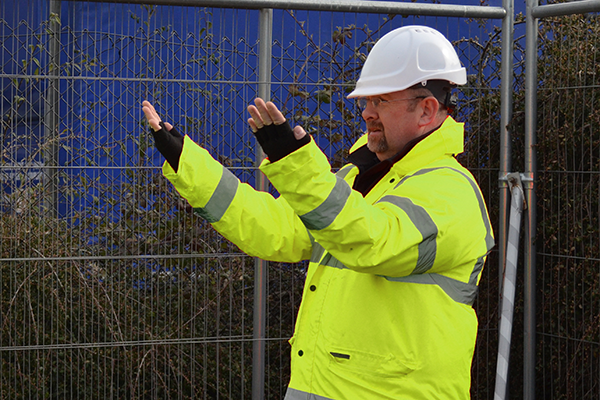
We are pleased to announce the release of our brand-new Workplace Transport Marshal Training course, designed to reduce risk for those working onsite.
Where vehicles and pedestrians share the same area, there is always an inherent level of risk. Over the last ten years, HSE statistics on employees indicate that being struck by a moving vehicle accounted for 1,264 non-fatal injuries and 9 fatalities reported under RIDDOR.
Wherever possible, segregation is key, but some scenarios require further measures to ensure all parties are protected. For example, when the operator cannot safely obtain a clear view of the route ahead, risk increases dramatically, putting them and those around them in danger.
In response to challenges facing the industry, we have developed a brand-new course which equips businesses with a valuable safety solution to assist in high-risk areas.
Workplace Transport Marshal training provides colleagues with the skills and knowledge to act as a chaperone, helping operators to ensure that equipment can be manoeuvred safely around site without causing harm to people or damage to buildings, stock or the equipment itself.
The half-day course covers all key elements, including compliance with the Health & Safety at Work etc Act 1974, clarification on where and when this method can be used and safe systems of work, alongside full practical training. The course is available on customer sites nationwide and accredited by the Association of Accredited Truck Trainers (AITT) to confirm its alignment with all relevant standards.
Our Commercial Director, Adam Smith, explains its importance, “This new course was developed to ensure both the operator and any pedestrians working around them remain safe onsite. Large loads can impair operator visibility and, where it’s not possible to drive in reverse, or environmental factors like tight corners come into play, assistance is vital.”
“In our experience of working with a wide range of companies, we understand that many working environments warrant supplementary solutions to reinforce existing segregation in shared areas. Pedestrians may underestimate the hazards, bypassing barriers or crossing the paths of vehicles they perceive to be slow-moving, and inadvertently put themselves in harm’s way. Trained marshals can ensure the operator’s route is clear, communicate with the driver and prevent them from leaning out of the confines of the vehicle for a better view.”
Adam concludes, “If you have operators and pedestrians working closely together, and you fail to mitigate the risks, you are putting your people and your business in danger. The simple addition of trained marshals to guide workplace transport in these instances can significantly reduce the risk of serious accidents and injuries, ensuring that everyone on site returns home safely at the end of the day.”
For further information on Workplace Transport Marshal training, contact us or call 01246 555222 and speak with one of their expert advisors.